A Constitutional Framework for Self-Government
The Constitution protects people from unaccountable power. It keeps decisions close to the public and sets clear limits on what the federal government may do. Those limits are more structural than they are symbolic.
This project takes a Jeffersonian and Madisonian view of the Constitution. It treats the text as a binding grant of “few and defined” powers to the federal government, with “numerous and indefinite” powers reserved to the states and to the people.
Madison wrote in Federalist No. 45: “The powers delegated by the proposed Constitution to the federal government are few and defined.” That principle remains essential for effective self-government.
Article I, Section 8 lists the powers of Congress. These are grants of authority and also limits. Each power has a specific meaning rooted in the founding era.
Enumerated Powers
1) Lay and collect taxes, duties, imposts, and excises to pay debts and provide for the common defense and general welfare, applied uniformly across the United States
This allows Congress to raise revenue for national purposes. The spending must support the limited federal responsibilities listed in the Constitution.
2) Borrow money on the credit of the United States
This allows Congress to issue debt for legitimate federal functions. It does not authorize borrowing for programs outside the enumerated powers.
3) Regulate commerce with foreign nations, among the states, and with Indian tribes
The founding understanding of “commerce” referred to trade and exchange. It did not include manufacturing, agriculture, labor, or general economic activity. The power covers the handshake between parties across jurisdictional lines. It does not reach production or consumption inside a state.
4) Establish uniform rules of naturalization and bankruptcy
These rules must be uniform across the country. They do not authorize broader control over immigration policy or private financial management.
5) Coin money, regulate its value, and fix standards of weights and measures
This ensures a stable national currency and consistent measurements.
6) Punish counterfeiting of U.S. securities and coin
This protects the integrity of the national currency.
7) Establish post offices and post roads
This supports communication and national connectivity. It does not authorize general infrastructure programs.
8) Promote the progress of science and useful arts through patents and copyrights
This protects intellectual property for limited times. It does not authorize federal control over research, education, or industry.
9) Constitute tribunals inferior to the Supreme Court
This allows Congress to create federal courts for federal cases.
10) Define and punish piracies and felonies on the high seas and offenses against the law of nations
This covers crimes outside state jurisdiction and matters involving international law.
11) Declare war
This places the decision for war in the hands of the people’s representatives.
12) Raise and support armies, with appropriations limited to two years
This ensures civilian control and regular review of military funding.
13) Provide and maintain a navy
This supports national defense at sea.
14) Make rules for the government and regulation of land and naval forces
This governs the conduct and structure of the armed forces.
15) Provide for calling forth the militia to execute laws, suppress insurrections, and repel invasions
This allows temporary federal use of state militias for specific emergencies.
16) Provide for organizing, arming, and disciplining the militia
This sets standards for militia readiness while leaving appointment of officers to the states.
17) Exercise exclusive legislation over the federal district and federal enclaves
This covers the seat of government and federal properties.
18) Make all laws necessary and proper for carrying out these powers
This allows Congress to choose reasonable means to execute its listed powers. It supports the enumerated powers rather than expanding them.
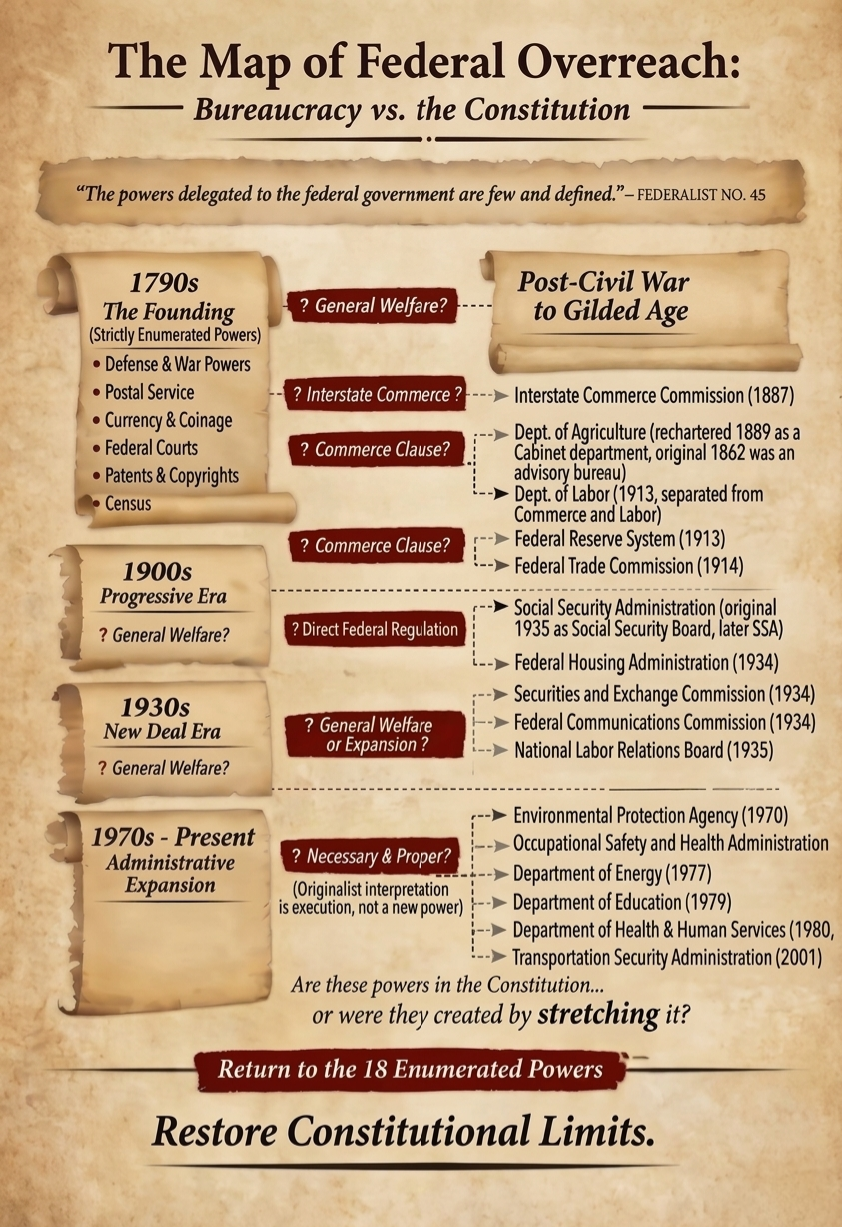
Over two centuries, federal authority expanded far beyond the original eighteen powers. This map illustrates how agencies and programs grew through interpretations of “General Welfare,” “Commerce,” and “Necessary & Proper.”
Gatekeeping and the Collapse of Local Representation
Structural failure occurs both at the federal level and within the electoral process. Agencies operate beyond enumerated powers. Political parties act as gatekeepers, selecting candidates long before the public participates. The voter enters the process only after the real decisions have already been made.
The mechanisms of gatekeeping, including insider endorsements/nominations, committee filtering, and pre-primary sorting, ensure that most citizens never encounter a genuine choice.

The effects of gatekeeping are measurable. Signature windows, closed primaries, and organizational paralysis create structural barriers that prevent genuine representation. The disparity in signature collection across wards is evidence of systemic failure.
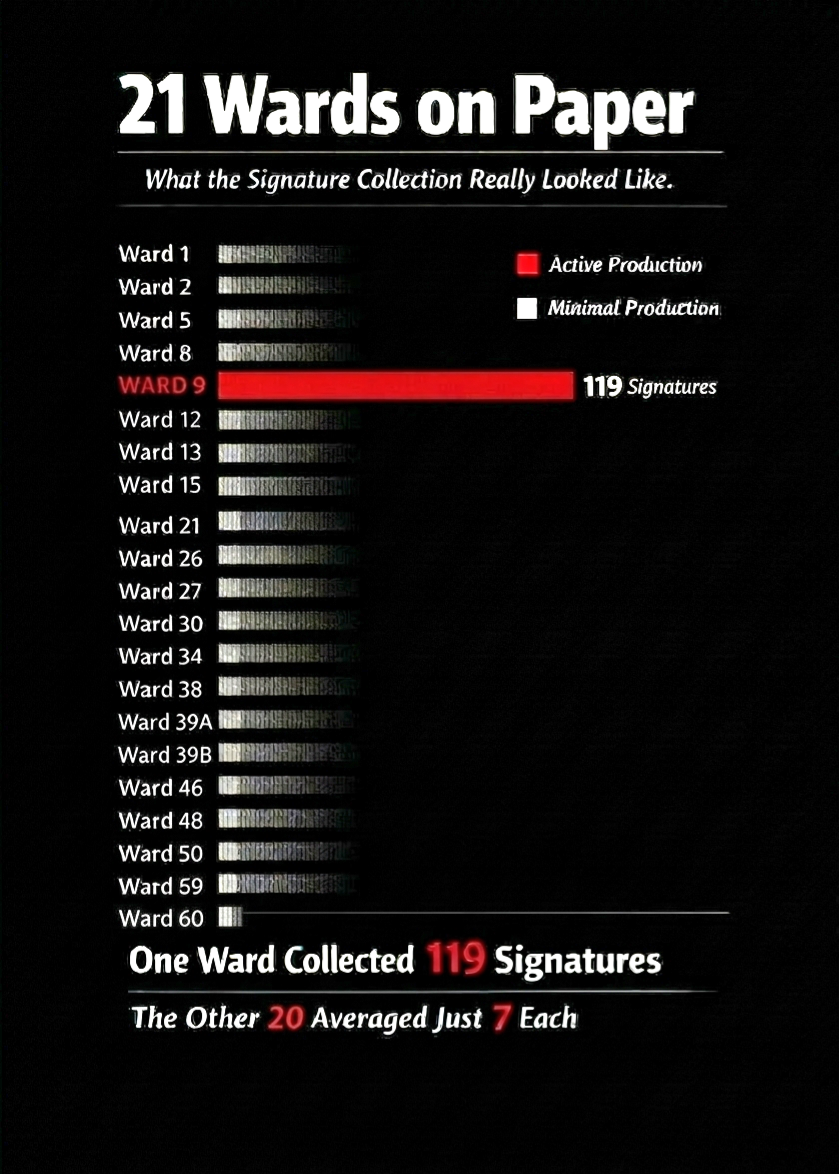
I experienced firsthand one ward producing 119 signatures. The other twenty averaged just seven each. This is what structural exclusion looks like in practice: a system where participation is theoretically open but functionally inaccessible.
Restoring the Enumerated Standard
Restoration requires returning to the original boundaries. Clauses such as General Welfare, Commerce, and Necessary and Proper must be interpreted according to their founding meaning.
If Congress possessed general authority, the Framers would not have listed specific powers. Enumerated powers exist precisely because federal authority is limited.
The Path to Restoration
Structural reform is necessary: proportional allocation of electoral votes, open primaries, and local-only campaign contributions. These changes restore the principle that representatives answer to the people who live in the community they serve.
What This Means in Practice
- Read every bill through the lens of Article I, Section 8
- Oppose federal programs that belong at the state or local level
- Support reforms that increase transparency, accountability, and fiscal discipline